
The island of Taiwan, long celebrated as the fortress of global semiconductor manufacturing, is currently undergoing a profound metamorphosis. It is no longer content with merely supplying the hardware that powers the world’s artificial intelligence systems; it is now aggressively forging its own path as a center of AI innovation, ethical governance, and international technological diplomacy. Throughout late 2025 and early 2026, a cascade of strategic announcements has painted a clear picture: Taiwan is deepening its AI partnerships on multiple fronts from the battlefields of Eastern Europe to the boardrooms of Silicon Valley, and from academic alliances in Northeast Asia to policy alignment at the Asia-Pacific Economic Cooperation (APEC) forum.
This comprehensive rewrite examines the multifaceted dimensions of Taiwan’s deepening AI partnership strategy. It explores the geopolitical trilateral cooperation with the Baltic states, the defense-oriented autonomy pact with Shield AI, the landmark passage of the Artificial Intelligence Basic Act, the economic tidal wave driven by NVIDIA’s investment, and the grassroots academic exchanges seeding future innovation. By weaving these threads together, we observe a nation executing a deliberate, high-stakes strategy to secure its place as a sovereign AI power.
The Baltic Bridge: Trilateral Tech Diplomacy in Action
In late October 2025, a significant yet understated diplomatic event unfolded in Riga, Latvia. The annual science and technology cooperation conference brought together Taiwan, Latvia, and Lithuania, marking over two decades of sustained scientific partnership . What began in 2000 as a trilateral research fund has matured into a sophisticated dialogue on the most cutting-edge domain of our time: artificial intelligence.
National Science and Technology Council (NSTC) Deputy Minister Chen Bing-yu led the Taiwanese delegation, co-chairing the conference with his Baltic counterparts. The meeting was not merely ceremonial; it served as a rigorous review of joint research outcomes and a selection process for new collaborative projects. This year, the spotlight shone intensely on AI development .
Taiwan used this platform to introduce its “Ten Major AI Projects,” a sweeping initiative targeting smart applications, critical underlying technologies, and robust digital infrastructure. Furthermore, the delegation promoted the “Southern Taiwan Silicon Valley” program, based in the Shalun Smart Green Energy Science City in Tainan. This initiative is designed to function as a living laboratory, linking government resources, private industry, and academic research institutions in a cohesive ecosystem .
The Baltic states, strategically positioned between the European Union and the geopolitical pressures of Eastern Europe, are themselves pivoting toward smart specialization. Latvian officials explicitly outlined their national plan to expand expertise in smart technology and digital information. Similarly, Lithuanian representatives expressed a strong appetite for constructing robust AI partnerships that bridge universities and industrial sectors . For Taiwan, this partnership is multidimensionally strategic. It not only opens a gateway to European AI research and standards-setting bodies but also cultivates diplomatic goodwill among nations that share Taiwan’s commitment to democratic governance and technological transparency.
Defending the Skies: The Shield AI and NCSIST Breakthrough
Perhaps the most tangible and aggressive manifestation of Taiwan’s AI deepening is found in the defense sector. On February 10, 2026, Shield AI, a prominent American defense technology company, announced a formal contract with Taiwan’s National Chung-Shan Institute of Science and Technology (NCSIST) . This agreement is not a simple procurement deal; it is a comprehensive technology transfer and co-development pact designed to accelerate and indigenize Taiwan’s development of AI pilots for unmanned systems.
At the heart of this collaboration is Shield AI’s proprietary Hivemind platform. Unlike conventional autopilots that rigidly follow preprogrammed flight paths, Hivemind is a sophisticated artificial intelligence capable of sensing its environment, making real-time decisions, and executing complex missions autonomously. It can reroute around no-fly zones, dynamically avoid obstacles, and respond to unexpected combat conditions all without human intervention. Crucially, it is engineered to operate in contested environments where GPS and communications are severely jammed or entirely denied .
For Taiwan, this capability is existential. The island faces a unique asymmetric warfare threat, requiring a defense posture that relies on survivability and advanced technology. Under this contract, NCSIST will integrate the Hivemind Software Development Kit (SDK) into indigenously developed drone platforms. The partnership enables a single ground control operator to supervise multiple unmanned systems simultaneously, a force multiplier that directly addresses Taiwan’s manpower limitations .
Brandon Tseng, president and co-founder of Shield AI and a former U.S. Navy SEAL, emphasized the company’s deep commitment to Taiwan’s defense ecosystem. The firm has already established a local office in Taipei 101, actively hiring Taiwanese engineers and technical staff. This localization strategy is deliberate. By embedding within Taiwan’s industrial landscape, Shield AI is helping to cultivate a domestic supply chain for autonomous combat capabilities . This partnership, which follows a previous teaming agreement with Taiwan’s Aerospace Industrial Development Corporation (AIDC), signals the maturation of Taiwan’s defense AI sector from conceptual research to operational fielding .
The Legislative Cornerstone: Implementing the AI Basic Act
Deepening AI partnerships is not solely about writing code or signing contracts; it requires a robust legal and ethical architecture. Recognizing this imperative, Taiwan officially promulgated its long-anticipated Artificial Intelligence Basic Act on January 14, 2026 . This legislation represents the island’s first comprehensive governance framework for AI, establishing clear rules of the road for both public and private sector development and deployment.
The Basic Act is deliberately broad in its definition of AI, covering systems that, through machine learning and algorithms, generate outputs such as predictions, content, recommendations, or decisions that influence physical or virtual environments. This expansive scope ensures that the law remains relevant across diverse applications, from healthcare diagnostics to autonomous vehicles .
A. Seven Core Governance Principles
The Act mandates that all government agencies adhere to seven fundamental principles when formulating subordinate regulations and administrative guidance :
-
Sustainability: AI development must consider environmental sustainability and the long-term welfare of humanity.
-
Human Autonomy: Respect for fundamental human rights and cultural values, allowing for human oversight and intervention.
-
Privacy and Data Governance: Protection of personal data and trade secrets, adherence to the data minimization principle, and the promotion of non-sensitive data reuse.
-
Cybersecurity: Robust security measures to ensure system robustness and resilience against malicious attacks.
-
Transparency and Explainability: Appropriate disclosure and labeling of AI-generated outputs to facilitate risk assessment and trust.
-
Fairness and Non-Discrimination: Mitigation of algorithmic bias to prevent discrimination against specific groups.
-
Accountability: Clear assignment of internal governance and external social responsibilities among different roles.
B. Bifurcated Governance Structure
The Act innovatively divides supervisory authority. The National Science and Technology Council (NSTC) is designated as the central competent authority, responsible for overarching development strategy and cross-ministerial coordination. Simultaneously, the Digital Affairs Ministry (MODA) is empowered to construct a “AI Risk Classification Framework” and manage “high-risk AI governance.” This risk-based approach mirrors the EU AI Act, requiring high-risk applications to display clear warnings and eventually comply with stringent verification and insurance obligations .
C. Risk-Based Management and Future Compliance
MODA is expected to formally submit the finalized Risk Classification Framework to the Executive Yuan by the first quarter of 2026. Specific attention is mandated for risk assessments concerning children’s rights, human rights, gender equality, and labor rights in the workplace. While the Basic Act currently lacks punitive sanctions, it establishes an accountability architecture that will evolve to include compensation mechanisms and mandatory insurance for high-risk AI operators . This legislation provides international partners with the assurance that Taiwan is not only an AI innovator but also a responsible steward of the technology.
The NVIDIA Shockwave: Economic Hegemony and Infrastructure Anxiety
No discussion of Taiwan’s AI ascent is complete without addressing the elephant in the room—or rather, the green logo in the room. On February 11, 2026, NVIDIA Corporation formalized a contract with the Taipei City Government to establish its first overseas headquarters in Taiwan. Located in the Beishi-Tucheng Technology Park, this NT$40 billion (approximately $1.25 billion USD) investment is projected to generate over 10,000 high-value jobs .
This decision is both a validation of Taiwan’s AI potential and a stress test of its infrastructure resilience. Taiwan Semiconductor Manufacturing Company (TSMC) has already emerged as the indispensable enabler of the global AI boom. In 2025, TSMC reported full-year revenue of NT$3.81 trillion, with High-Performance Computing (HPC) accounting for 58% of this turnover . NVIDIA’s decision to anchor its physical headquarters in Taipei signals a strategic bet that Taiwan will evolve from a silicon foundry into a comprehensive AI innovation hub.
However, this rosy scenario is shadowed by stark vulnerabilities. Expert commentary has highlighted two existential threats: energy supply and talent retention .
A. The Energy Dilemma
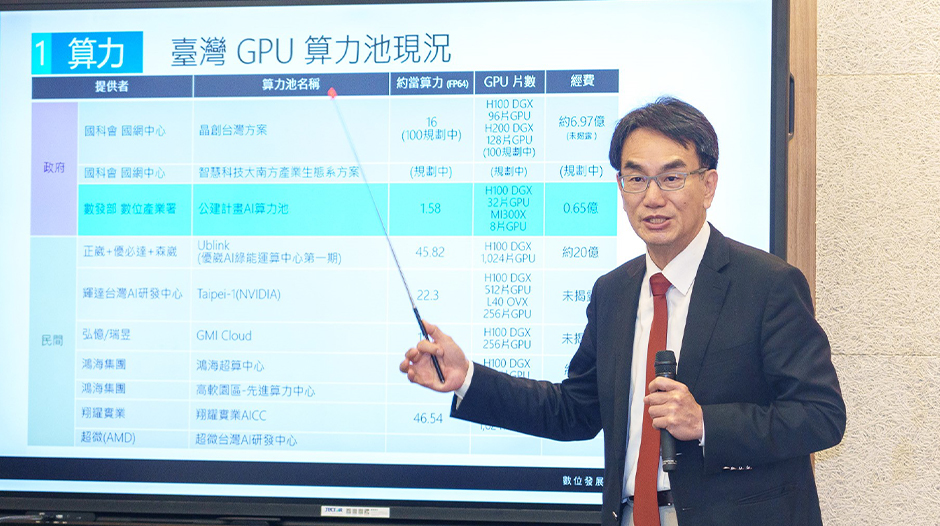
AI data centers are ravenous consumers of electricity. Taiwan’s power consumption from data centers is projected to explode from 240MW in 2023 to over 2,200MW by 2028. This tenfold increase collides with the island’s constrained energy grid and its heavy reliance on imported fossil fuels. While the government is aggressively investing in offshore wind and solar energy,储能 technology and grid reliability remain Achilles’ heels . Encouragingly, Taiwan is leveraging AI itself to solve this problem. At the APEC Energy Ministerial Meeting in Busan, Vice Minister of Economic Affairs Chien-hsin Lai showcased Taiwan’s “Adaptive Cold Energy Management System” (ACEMS), implemented in convenience stores, which leverages intelligent energy management to reduce peak loads by 10-15% . This demonstrates a virtuous cycle: AI drives energy demand, but it also provides the tools to manage it efficiently.
B. The Human Capital Challenge
Taiwan currently trains approximately 8,000 AI application specialists and 600 research experts annually. Yet a significant portion of this talent pool is lost to overseas opportunities due to a lack of domestic application opportunities. Taiwan ranks 33rd globally in advanced AI talent, 30th in commercial ecosystems, and 27th in core development capabilities . Recognizing this, the government’s “New Ten Major AI Constructions” allocates significant resources toward cultivating 500,000 AI professionals by 2040, but bridging the immediate gap requires aggressive international recruitment and the return of overseas Taiwanese experts .
Pacific Partnerships: APEC and the American Alliance
Parallel to these bilateral and defense initiatives, Taiwan has been diligently weaving AI cooperation into the multilateral fabric of the Asia-Pacific. During the APEC Digital Ministerial Meeting held in Incheon, South Korea, in August 2025, Taiwan’s Digital Minister Huang Yen-nun secured deeper alignment with the United States on digital and AI policy .
The summit produced the first joint ministerial statement specifically addressing digital and AI policy. Member economies pledged to enhance connectivity, bridge digital divides, promote trustworthy AI, and accelerate responsible technology adoption. Minister Huang explicitly framed Taiwan’s domestic digital goals fraud prevention, infrastructure resilience, and digital economy expansion as being in perfect alignment with the APEC declaration .
A key ally identified during these talks was Michael Kratsios, then-director of the White House Office of Science and Technology Policy. Bilateral discussions with Japan and Southeast Asian nations also explored regional cooperation in emerging technologies . This diplomatic activity underscores a critical dimension of Taiwan’s AI deepening: it is not a zero-sum game. By harmonizing its governance frameworks with international partners, Taiwan reduces friction for cross-border data flows and attracts foreign investment.
Grassroots Innovation: Academic Alliances and Smart Healthcare
While governmental and defense contracts capture headlines, the long-term vitality of Taiwan’s AI ecosystem depends on educational exchange and grassroots research collaboration. A compelling example emerged in late December 2025, when Southern Taiwan University of Science and Technology (STUST) launched the “Taiwan-Korea AI Alliance” with Korea’s Donggang University .
This partnership transcends typical student exchange programs. It is a strategic, interdisciplinary alliance focused on smart healthcare and sports technology. STUST is integrating its “Smart Healthcare Medical Technology Center” and “Sports Technology Center” with Donggang University’s engineering research capabilities .
The collaboration framework includes:
A. Co-construction of AI Teaching Modules: Developing standardized, high-quality AI curricula that can be delivered across both institutions.
B. Joint Research Projects: Focusing on practical applications such as health monitoring systems, motion performance analysis, and intelligent assistive devices.
C. Cross-border Education Platforms: Creating a sustainable mechanism for faculty and student exchanges, enabling Taiwanese and Korean students to collaborate on AI solutions for aging populations and chronic disease management.
This initiative demonstrates that Taiwan’s AI deepening strategy is comprehensive. It operates at the altitude of geopolitical diplomacy and at the ground level of university laboratories. By investing in international educational partnerships, Taiwan is cultivating a generation of AI practitioners who are inherently global in their outlook and technical training.
Economic Momentum and Future Forecasts
The cumulative effect of these deepening partnerships is already visible in macroeconomic indicators. Bloomberg reported in mid-February 2026 that Taiwan is poised to upgrade its economic growth forecast for the year, propelled by sustained AI demand and the finalization of a trade pact with the United States . Taiwan’s statistics bureau had previously projected 3.5% growth in November 2025, a figure considered conservative given the subsequent influx of capital and industrial activity.
Economists now project potential growth rates ranging between 4.8% and 8% for 2026, with AI-related exports serving as the primary locomotive . The government’s investment of NT$190 billion into the “New Ten AI Constructions” is projected to generate an estimated NT$15 trillion in economic value by 2040 . These figures, while staggering, are contingent upon Taiwan successfully navigating its energy transition and talent deficits.
Conclusion: The Sovereign AI Imperative
Taiwan’s deepening of AI partnerships is not a passive response to global trends; it is an assertive, sovereign strategy. From the Baltic capitals to the skyscrapers of Taipei 101, from the legislative chambers passing the AI Basic Act to the university laboratories incubating Korean-Taiwanese health tech research, the island is methodically constructing an AI ecosystem defined by resilience, autonomy, and interoperability.
The collaboration with Shield AI addresses immediate defense imperatives, ensuring that Taiwan’s asymmetric deterrence capabilities remain credible in a GPS-denied battlefield. The trilateral partnership with Latvia and Lithuania opens pathways into European research networks and affirms Taiwan’s identity as a contributor to democratic technology governance. The NVIDIA headquarters investment, despite its accompanying anxieties, signals deep private-sector confidence in Taiwan’s engineering workforce and strategic importance. Finally, the AI Basic Act provides the essential regulatory confidence that allows innovation to flourish without sacrificing public trust.
As the world transitions from the era of AI experimentation to the era of AI industrialization, Taiwan is uniquely positioned. It possesses the hardware supply chain that competitors cannot replicate, the democratic governance that partners trust, and now, the strategic clarity to unite these assets under a coherent national vision. The challenges of energy, talent, and geopolitical pressure are substantial, but the trajectory is undeniable. Taiwan is no longer just the world’s chip foundry; it is emerging as a sovereign architect of the artificial intelligence age.