
Fifty-three years have quietly slipped by since humanity last sent its representatives to the celestial neighbor that has captivated our imagination since the dawn of consciousness. In the intervening decades, the Moon remained a destination visited only by robots sophisticated orbiters, landers, and rovers that served as our mechanical proxies. But that prolonged intermission is finally ending. Perched atop a monumental 322-foot pillar of engineering and ambition, four astronauts are preparing to ride a controlled explosion into the black void, marking the first time since 1972 that human beings will venture beyond low Earth orbit and set a course for the Moon. This is Artemis II, and it represents far more than a nostalgic echo of the Apollo program; it is the long-awaited prologue to humanity’s next great evolutionary leap as a multiplanetary species .
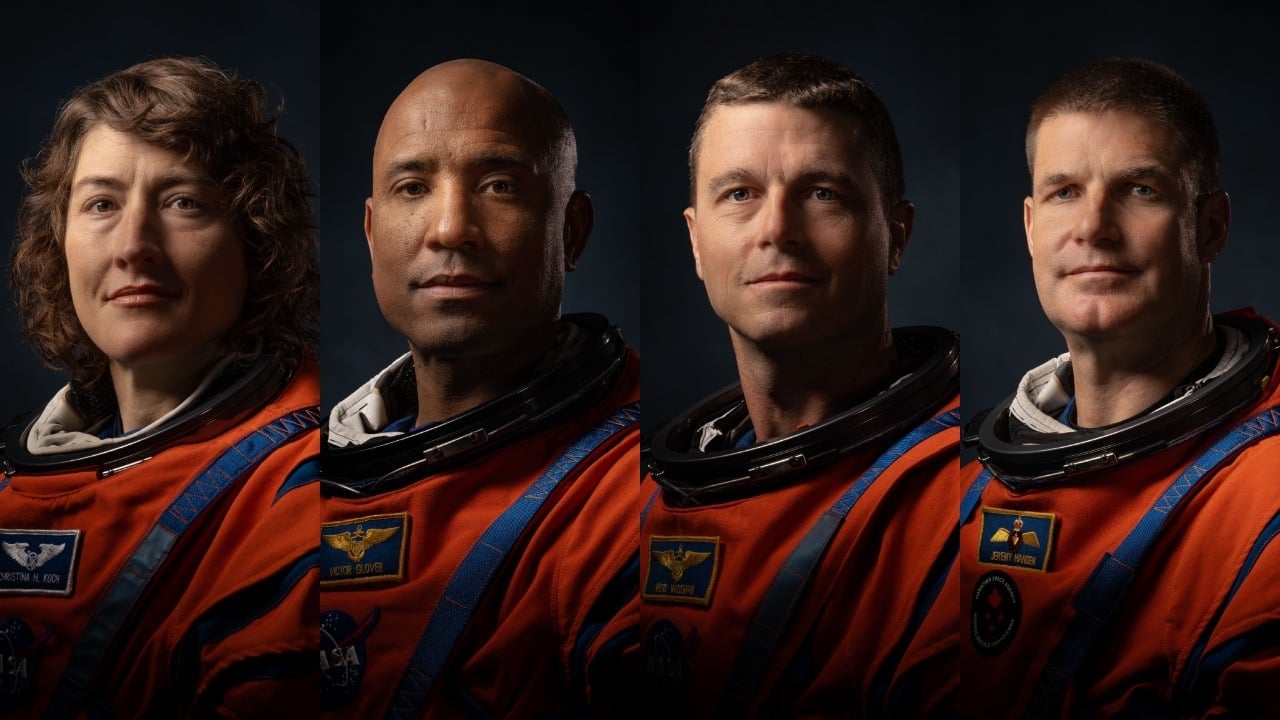
The mission, designated Artemis II, is the inaugural crewed flight of NASA’s Space Launch System and the Orion spacecraft. While it will not touch the lunar dust that honor belongs to Artemis III, scheduled for no earlier than 2027 or 2028 its 10-day trajectory will carve a majestic figure-eight through cislunar space, carrying its crew farther from Earth than any humans have ever traveled . The stakes could not be higher. This is not merely a commemorative lap; it is a high-stakes systems verification test conducted in the most unforgiving laboratory imaginable. The lives of Commander Reid Wiseman, Pilot Victor Glover, and Mission Specialists Christina Koch and Jeremy Hansen depend on the flawless performance of thousands of components, while the future of the entire Artemis architecture including the lunar Gateway, the Human Landing System, and the eventual Mars missions hinges on the data they bring home .
As of early February 2026, the world watches with bated breath. The massive vehicle has already completed its solemn, 12-hour procession from the Vehicle Assembly Building to Launch Complex 39B, the very same pad from which Apollo 10 once departed. A wet dress rehearsal conducted on February 2 successfully loaded over 700,000 gallons of cryogenic propellant into the rocket’s belly, though it also revealed a liquid hydrogen leak that prompted mission managers to prudently reschedule the launch window from early February to a new opportunity beginning March 6, 2026 . This is the nature of deep-space exploration: patience, precision, and the constant negotiation between ambition and safety. But the waiting only magnifies the profound significance of what is about to occur.
The Architects of History: Meet the Crew of Artemis II
To understand the magnitude of Artemis II, one must first understand the four individuals who have volunteered to strap themselves to the most powerful rocket ever built. They are not merely passengers; they are the distillation of decades of collective experience, academic rigor, and the uniquely human capacity for courage.
A. Commander Reid Wiseman
At the helm is Reid Wiseman, a 50-year-old Baltimore native whose career arc reads like a manifesto for American excellence. A decorated U.S. Navy Captain and former Naval aviator, Wiseman earned his wings through the crucible of combat and carrier operations before joining NASA’s 20th astronaut class in 2009. His previous spaceflight experience includes a 165-day mission aboard the International Space Station in 2014, during which he conducted two spacewalks and served as a flight engineer. Between 2020 and 2022, he held the demanding role of Chief of the Astronaut Office, placing him at the nerve center of human spaceflight policy and crew selection. Wiseman is the calm in the storm, the steady hand on the controls, and the leader tasked with guiding his crew through the most consequential test flight since Apollo 8 .
B. Pilot Victor Glover
Sitting beside Wiseman is Pilot Victor Glover, a 49-year-old U.S. Navy Captain who is about to inscribe his name in the history books as the first person of color to venture beyond low Earth orbit. Glover’s credentials are staggering: over 3,000 flight hours, 24 combat missions, three master’s degrees in engineering, military art, and test piloting, and a previous six-month tour on the ISS as the pilot of the first operational SpaceX Crew Dragon mission. During that expedition, he performed four spacewalks and logged 168 days in space. His grandfather was a pilot; his father was an engineer. Glover carries their legacy with him as he prepares to pilot Orion through its critical proximity operations demonstration and, ultimately, around the far side of the Moon .
C. Mission Specialist Christina Koch
Christina Koch, 47, is the mission’s civilian scientist and arguably its most seasoned veteran of extreme environments. Before she was an astronaut, she was a researcher at the South Pole, wintering over in Antarctica as part of a firefighting team and scientific crew. She developed instruments for the Juno mission to Jupiter and worked in the remote Arctic. In space, she holds the record for the longest single spaceflight by a woman 328 consecutive days and participated in the first all-female spacewalk. A rock climber and surfer who thrives on physical and intellectual challenge, Koch will become the first woman ever to travel to the Moon. Her role on Artemis II is not ceremonial; she is a highly trained geologist and observer whose eyes will serve as one of the mission’s most sensitive scientific instruments .
D. Mission Specialist Jeremy Hansen
Rounding out the quartet is Jeremy Hansen, a 50-year-old Colonel in the Royal Canadian Air Force and the first non-American to embark on a deep-space mission. Hansen’s path to this launch pad is a testament to international partnership. Selected as part of the Canadian Space Agency’s 2009 astronaut corps, he has never flown in space before but he has trained in the most challenging environments Earth can offer. He spent seven days as an aquanaut in the Aquarius undersea laboratory and another six days underground as a “cavenaut” with the European Space Agency, studying geology and team dynamics in isolation. His presence on Artemis II is a direct result of the Canada-U.S. Gateway Treaty, which secured Canadian astronaut flight opportunities in exchange for Canada’s critical contribution of advanced external robotics for the lunar Gateway. Hansen represents the fundamental truth that the return to the Moon is not an American endeavor alone, but a global one .
The Giant’s Awakening: SLS, Orion, and the Rollout
Before the crew can fly, the machine must prove its readiness. On January 17, 2026, at 7:04 AM EST, the Artemis II stack comprising the Space Launch System Block 1 rocket and the Orion spacecraft, which the crew has christened Integrity began its slow, methodical journey from the Vehicle Assembly Building to Launch Pad 39B .
The rollout is a logistical ballet of immense scale. The SLS and its mobile launcher are carried by Crawler-Transporter 2 (CT-2), a behemoth that ranks as the heaviest self-powered land vehicle on the planet. Combined, the stack weighs approximately 15 million pounds significantly heavier than the Saturn V and Space Shuttle stacks that previously traversed the same crawlerway. This pathway, originally constructed during the Apollo era, is deliberately paved with smooth river rock that acts as a bed of ball bearings, absorbing the colossal energy of the load. The journey covers just 4 miles and takes nearly 12 hours, with the crawler moving at less than one mile per hour to ensure stability .
Upon arrival at the pad, engineers immediately began the intricate work of connecting the vehicle to ground infrastructure: electrical power, environmental control systems, and cryogenic propellant lines. The launch tower, Mobile Launcher 1, has undergone extensive repairs and upgrades since its service during Artemis I. The sound waves and exhaust from the RS-25 engines and solid rocket boosters had previously damaged elevator doors, pneumatic lines, and cabling; these have been reinforced. A new slide-wire emergency egress system has been installed, offering the crew a rapid escape route should a catastrophic malfunction occur during the final countdown .
The subsequent wet dress rehearsal, conducted in early February, was the ultimate pre-flight stress test. Engineers loaded the vehicle with its full complement of liquid hydrogen and liquid oxygen, rehearsed countdown procedures, and simulated the handoffs between the launch team and the crew. However, the rehearsal was not without incident. A liquid hydrogen leak was detected, requiring troubleshooting and valve retorquing. Additionally, teams grappled with audio communication dropouts and the complicating factor of unseasonably cold weather sweeping across Florida. Although the February launch windows spanning dates such as the 6th, 7th, 8th, 10th, and 11th were ultimately scrubbed, the successful resolution of these issues during the rehearsal cycle is precisely why such tests exist. NASA has since identified new launch periods spanning late February through mid-April, with March 6 emerging as the earliest viable opportunity .
Dissecting the Trajectory: How Artemis II Will Fly
The flight path of Artemis II is a masterwork of astrodynamics, balancing the need for rigorous systems testing with the imperative of crew safety. Unlike the Apollo missions, which inserted crews into orbit around the Moon, Artemis II will execute a hybrid free return trajectory. This profile leverages the gravitational interplay between Earth and the Moon to create a self-correcting path: once Orion rounds the far side, Earth’s gravity will naturally pull it back home without the need for a critical engine burn to leave lunar orbit .
Phase 1: Ascent and Earth Orbit
The mission commences with the thunderous ignition of the SLS Block 1. The four RS-25 engines, alongside the twin five-segment solid rocket boosters, generate 8.8 million pounds of thrust at liftoff. Within minutes, the boosters separate, the launch abort system jettisons, and the core stage shuts down and detaches. The Interim Cryogenic Propulsion Stage (ICPS) takes over, guiding Orion into an initial elliptical parking orbit approximately 115 miles by 1,800 miles above Earth. This first orbit lasts just over 90 minutes .
Phase 2: High-Earth Orbit and Proximity Operations
Following systems checks, the ICPS fires again to raise Orion into a high-Earth orbit, stretching between 235 and 68,000 miles from the planet. This 42-hour orbit is the proving ground. Here, Orion separates from the spent ICPS, and the crew transitions to manual piloting mode. In a critical demonstration of handling qualities, Wiseman and Glover will turn Orion around, approach the tumbling upper stage, and practice rendezvous and proximity operations. This is not a docking there is no docking target on this mission but it is essential rehearsal for Artemis III, when Orion must link up with the Human Landing System in lunar orbit. The crew will back away, reposition, and assess the spacecraft’s responsiveness to manual inputs, generating data that cannot be replicated in simulators .
Phase 3: Trans-Lunar Injection
With the proximity demonstration complete, Orion’s service module engine ignites for the Trans-Lunar Injection burn. This is the moment of commitment. Accelerating to approximately 24,500 mph, the spacecraft breaks the bonds of Earth’s gravity well and sets sail for the Moon. The outbound voyage spans approximately four days. During this period, the crew will test the life support systems, evaluate the radiation shelter, and cross beyond the range of GPS and NASA’s Tracking and Data Relay Satellites, transitioning to the Deep Space Network for communications .
Phase 4: The Lunar Flyby
The signature event of the mission occurs as Orion swings behind the Moon. At its closest approach, the spacecraft will fly a mere 6,479 miles above the lunar surface significantly closer than the 4,600 miles previously advertised in early planning documents, though still well outside of low lunar orbit. This proximity places the crew directly over terrain that has never been seen by human eyes. For three hours, the windows of Orion will frame landscapes that exist only in satellite imagery and scientific speculation .
The far side of the Moon is not dark; it is simply unseen. Synchronous tidal locking ensures that the Moon rotates at precisely the same rate it orbits Earth, forever hiding one hemisphere from terrestrial view. The Artemis II astronauts will witness this hidden realm bathed in full sunlight. Commander Wiseman has spoken of his awe upon realizing that a geology textbook image of the Orientale Basin a massive impact feature has never actually been observed directly by a person. “That made my hair stand up,” he admitted .
Phase 5: Return and Reentry
Following the flyby, Orion is on the return leg of the figure-eight. No propulsion is required for the homeward journey; the gravity of the Earth-Moon system does the work. Four days later, the spacecraft approaches Earth at nearly 25,000 mph Mach 32. The crew module separates from the service module, which burns up harmlessly in the atmosphere. Orion’s heat shield, the largest of its kind ever built, endures temperatures approaching 5,000 degrees Fahrenheit. A precisely choreographed sequence of drogue and pilot parachutes deploys, slowing the capsule from hypersonic velocity to a gentle 20 mph splashdown in the Pacific Ocean off the coast of California. Recovery teams, already stationed on station, will retrieve the crew and the spacecraft, closing the chapter on a 10-day journey exceeding 620,000 miles .
Science Riding Shotgun: The Hidden Payload of Human Observation

While Artemis II is fundamentally a test flight, it carries a scientific payload of immense value: the crew themselves. NASA has consciously woven science into the fabric of the mission with an intentionality that far surpasses the Apollo 8 precedent.
The astronauts are equipped with an array of biomedical instruments. They will wear wristbands to continuously monitor movement, sleep quality, and stress biomarkers. Radiation sensors in their pockets will quantify the dosage of galactic cosmic rays encountered beyond the protective bubble of Earth’s magnetosphere data vital for planning the longer-duration transit to Mars. They will collect saliva samples in small booklet-like stamps to track immune function changes. Most sophisticated of all, Orion carries organ-on-a-chip technology: USB-sized devices containing cells derived from the astronauts’ own blood, engineered to mimic bone marrow. Researchers will analyze how the genetic expression of these cells is altered by the deep-space environment .
Yet the most powerful scientific instrument aboard Orion is the pair of eyes behind each helmet visor. Christina Koch has emphasized that human vision excels at detecting nuance, texture, and color variation in ways that even the most advanced CCD sensors struggle to replicate. During Apollo 17, astronaut Harrison Schmitt spotted orange soil from orbit a discovery that led to the identification of 3.6-billion-year-old volcanic deposits. The Artemis II crew has trained extensively to replicate this kind of observational serendipity .
Their training has been immersive and multidisciplinary. The crew has attended classroom lectures in planetary geology, completed regular “Moon homework” assignments, and conducted field expeditions to Iceland and Arizona to study analog terrain. They have practiced inside mockups of Orion, gazing at inflatable lunar landscapes suspended from cranes, learning to articulate their observations in scientifically useful language. During one simulation, an astronaut described a feature as “looking like a kiss.” This is the lexicon of human exploration subjective, poetic, and irreplaceable .
Supporting the crew on the ground is an infrastructure that did not exist for Apollo. Dr. Marie Henderson of NASA’s Goddard Space Flight Center serves as the Deputy Lunar Science Lead for Artemis II, a role created specifically for this mission. She will direct a team of geologists and planetary scientists in the newly constructed Science Evaluation Room at Johnson Space Center. From this command post, her team will receive downlinked imagery and verbal descriptions in real time, analyze the data, and relay observation priorities back to the crew. Kelsey Young, the mission’s designated Science Officer embedded in Mission Control, will serve as the conduit between the scientists and the astronauts, ensuring that science objectives are weighed alongside engineering and safety considerations .
Henderson encapsulates the philosophical shift: “Our astronauts are scientists themselves. We think of them as an extension of our science team.” This is the maturation of human spaceflight, evolving from the fighter-jock era of the 1960s into an epoch where explorers are also investigators .
The Geopolitical Canvas: Why We Are Returning Now
To fully appreciate Artemis II, one must understand the geopolitical and economic context that catalyzed its creation. The obvious question why now, after five decades of absence? has a complex answer.
Following the Apollo program’s conclusion in 1972, the political will to fund human lunar exploration evaporated. The United States had won the Space Race; the strategic imperative was satisfied. Moreover, the cost was staggering: Apollo consumed approximately $258 billion in contemporary dollars, equivalent to over $300 billion today. For decades, the Moon was a destination without a compelling justification .
Two factors disrupted this equilibrium. The first was the democratization of space access. The emergence of commercial players like SpaceX and Blue Origin, developing reusable rocket technology, has drastically reduced the cost of lifting mass off the planet. This has not only enabled a new economy of space tourism but has also lowered the barrier to entry for sovereign space programs. Today, over 70 nations maintain their own space agencies .
The second, and arguably more urgent, catalyst is the rapid ascent of China’s lunar ambitions. In 2019, the Chang’e-4 mission achieved the first-ever soft landing on the far side of the Moon. In 2024, Chang’e-6 successfully returned the first samples from the lunar far side to Earth. These milestones, achieved with methodical efficiency, sent a clear signal to Washington. Dr. Namrata Goswami, a space policy expert, describes this as a “Sputnik moment” a realization that the United States was no longer competing against a legacy actor but against a peer competitor with advanced indigenous capabilities .
The stakes of this new race extend beyond national prestige. The lunar south pole, in particular, has emerged as the geopolitical prize of the 21st century. Spectroscopic analysis has confirmed the presence of water ice in permanently shadowed craters. This resource is the equivalent of oil in the desert: it can be electrolyzed into hydrogen and oxygen, providing breathable air, potable water, and critically rocket propellant. A fuel depot on the Moon would fundamentally alter the logistics of space exploration, enabling spacecraft to refuel for onward journeys to Mars without the astronomical expense of lifting propellant out of Earth’s deep gravity well .
Beyond water, the lunar regolith contains rare earth elements, structural metals such as iron, aluminum, and titanium, and an isotope of helium Helium-3 that is exceedingly rare on Earth but abundant on the lunar surface. Valued at an estimated $20 million per kilogram, Helium-3 holds theoretical promise as a fuel for next-generation nuclear fusion reactors. While the engineering challenges of extraction are formidable requiring the processing of tons of regolith for milligrams of harvest the mere potential of such resources has transformed the Moon from a scientific curiosity into a strategic territory .
The Artemis Accords, a U.S.-led framework for responsible lunar exploration, have been signed by dozens of nations. China and Russia, meanwhile, have announced their own parallel International Lunar Research Station. The race to the Moon is no longer a sprint; it is a decathlon with permanent settlement as the finish line. Artemis II is the first lap .
Overcoming Adversity: The Road to the Pad
The path to this launch has been anything but smooth. The Artemis I mission, an uncrewed test flight, endured repeated delays, hydrogen leaks, tropical storms, and four separate rollouts before finally launching on November 16, 2022. Artemis II inherited a vehicle and a program hardened by those struggles, but new challenges have emerged .
The February 2026 wet dress rehearsal was complicated by a rare Arctic cold front that swept across central Florida. Wind speeds and low temperatures pushed the operation outside of established safety tolerances, forcing a two-day slip in the schedule. The hydrogen leak, while resolved, necessitated additional troubleshooting and contributed to the decision to target the March window. These are not failures; they are the diligent application of flight rationale. The NASA culture that lost two Space Shuttles to organizational complacency has, through tragedy and reform, evolved into a culture that scrubs first and asks questions later .
There have also been hardware improvements. During the Artemis I processing flow, the Flight Termination System a range safety destruct mechanism could not be accessed once the vehicle was at the pad. Any issue with the system required a laborious rollback to the Vehicle Assembly Building. For Artemis II, engineers have modified the pad infrastructure to permit access to the termination system in situ, eliminating a potential weeks-long delay. This is the quiet, invisible work of engineering that makes history possible .
The View from the Window: What They Will See
Perhaps the most profound aspect of Artemis II is the perspective it offers. Victor Glover, reflecting on the mission, spoke of the weight of the idea that he and his crewmates will see things no human has ever seen. “We come to work to go fly spaceships,” he said. “We put humans in space, and we put space in humans. But boy, that to me was a heavy idea and reason.”
The Moon, as viewed from Orion’s windows, will not be the gray, static orb that hangs in Earth’s night sky. It will be a dynamic, three-dimensional world of highlands and basins, of crater walls casting long shadows and peaks catching the first rays of sunrise. The crew will have approximately three hours of close observation a fleeting moment compared to the days Apollo crews spent in orbit, but a luxury compared to the brief snapshots captured by robotic probes. They will look for fresh impact craters, perhaps observing a meteorite strike in real time. They will note subtle color variations in the regolith. They will describe the texture of the surface .
And then, as Orion emerges from behind the Moon, they will witness Earthrise. This image, first captured by Apollo 8’s Bill Anders, is credited with inspiring the modern environmental movement and shifting humanity’s perception of its own home. Fifty-eight years later, a new generation will see that blue marble hanging in the void. The image will be fresh, not archival. It will be seen, not simulated. And it will be shared with a world that is vastly more connected and vastly more in need of unifying moments than the world of 1968 .
Conclusion: The Threshold
As of this writing, the Artemis II stack stands illuminated by xenon arc lights on Launch Complex 39B. Technicians swarm the base, conducting final checks. The crew remains in quarantine at Johnson Space Center, maintaining peak physical condition and mental focus. Somewhere in the Pacific, recovery teams are rehearsing their procedures. Across the country and around the world, scientists are preparing their observation plans, not knowing exactly what data they will receive, but certain that it will be good .
The launch window in March 2026 is not a guarantee; it is an opportunity. Technical issues may emerge. Weather may intervene. The orbital mechanics of the Earth-Moon system are unforgiving of schedule slips. But these uncertainties are inherent to the enterprise of exploration. What is certain is that the threshold is near. The decades of waiting, the budget battles, the shifting presidential directives, the technical setbacks, and the incremental victories have all converged on this moment.
Four individuals will soon strap into a capsule named Integrity, and a machine of immense power will lift them toward the sky. They will go farther than any of the 8 billion people remaining on Earth. They will see what no one has seen. They will bring back not only data and imagery, but also a renewed sense of what is possible when a species dares to look beyond its cradle.
The Moon has waited 53 years for our return. It will wait a few more weeks. And then, finally, humans will be back in the neighborhood.