
For decades, the global memory semiconductor industry operated under a predictable hierarchy. South Korean giants Samsung Electronics and SK Hynix, alongside American powerhouse Micron Technology, dictated the pace of innovation while maintaining a comfortable technological moat. Chinese manufacturers, for their part, were relegated to the role of aggressive discounters churning out legacy DDR4 and low-end NAND flash for budget electronics, competing almost exclusively on price rather than performance.
That era has not merely ended; it has been obliterated. In a remarkably compressed timeline, China’s flagship memory houses ChangXin Memory Technologies (CXMT) in the DRAM sector and Yangtze Memory Technologies Co. (YMTC) in NAND flash have executed a strategic pivot so decisive that it has fundamentally redrawn the competitive topography of the industry . This is no longer a story of catch-up. It is a story of leapfrogging, of capacity reallocation toward artificial intelligence infrastructure, and of a nation’s determined march toward semiconductor sovereignty. This comprehensive feature explores the multi-dimensional facets of this upmarket migration, dissecting the technological breakthroughs, the brutal supply-demand economics, the geopolitical undercurrents, and the profound downstream consequences now reverberating from Shenzhen’s bustling electronics bazaars to the server farms powering China’s large language models.
A. The Strategic Exodus from Commodity Trenches
The most significant signal of China’s memory metamorphosis is not found in marketing brochures but in production manifests. Until late 2024, the conventional wisdom both in Seoul and Silicon Valley held that CXMT’s primary function was to flood the market with inexpensive DDR4, thereby compressing margins for the established players. This assumption has been rendered obsolete.
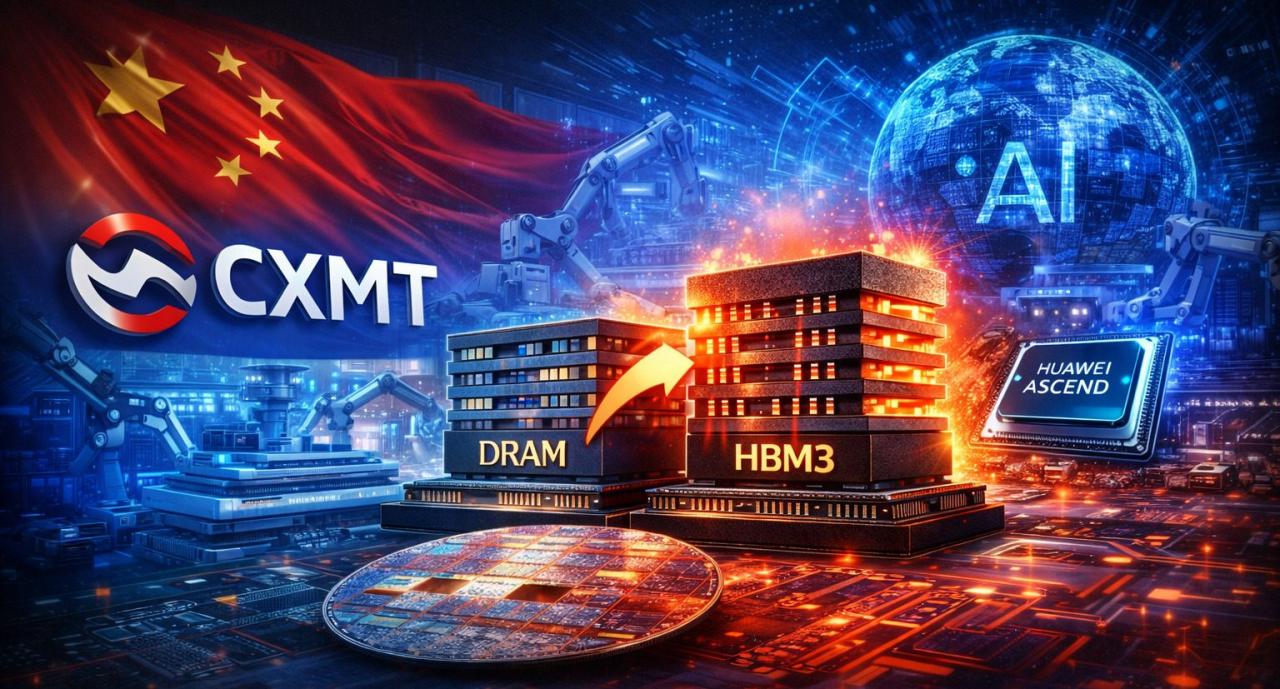
CXMT has largely ceased aggressive expansion of legacy DDR4 output, maintaining only minimal production runs for longstanding contractual partners. The company’s focus, resources, and cutting-edge wafer starts have pivoted decisively toward premium interfaces: DDR5, LPDDR5X, and most consequentially, High-Bandwidth Memory (HBM) . This is not a gradual evolution; it is a structural reallocation. Reports indicate that CXMT is converting approximately 20 percent of its total DRAM production an estimated 60,000 wafers specifically toward HBM3 stacks .
This shift carries profound implications. For years, Western analysts speculated that China’s entry into memory would serve as a pressure-release valve for consumer markets, suppressing prices for PC builders and gamers. This hypothesis rested on the assumption that Chinese firms would remain perpetually anchored in the commodity tier. That assumption has collapsed. By diverting one-fifth of its capacity to AI-centric memory products, CXMT is effectively tightening the very consumer DRAM market that it was expected to liberate.
YMTC has mirrored this trajectory in NAND. Having successfully commercialized 270-layer to 294-layer 3D NAND closing the layer-count gap with Samsung’s 286-layer and SK Hynix’s 321-layer offerings the company is no longer content with supplying generic storage . Instead, it is pushing into high-performance solid-state drives optimized for enterprise data centers and AI inference servers. The era of “good enough, cheap enough” is over; the era of “premium or nothing” has begun.
B. Technological Inflection: Closing the Gap Without EUV
The conventional narrative regarding China’s semiconductor limitations has long centered on extreme ultraviolet lithography. Without access to ASML’s Twinscan NXE systems, the logic went, Chinese fabs would remain permanently two to three nodes behind. CXMT’s recent product unveilings challenge this deterministic view with compelling evidence.
At the IC China 2025 exhibition in Beijing, CXMT showcased seven distinct advanced DRAM products, including DDR5 modules rated at a maximum speed of 8,000 megabits per second with individual die capacities reaching 24 gigabits . These specifications are not merely competitive; they are statistically comparable to the latest offerings from Samsung and SK Hynix. To achieve this using multi-patterning techniques on deep ultraviolet lithography equipment represents a triumph of process engineering over equipment restriction.
However, the technological hurdle for HBM3 is substantially higher than for commodity DDR5. HBM requires through-silicon vias, micro-bump interconnects, and complex thermal management solutions. Where Korean manufacturers utilize EUV for critical layers to enhance yield and reduce resistance-capacitance delay, CXMT must rely on quadruple patterning a technique that increases cycle time and defect probability .
The question of yield is therefore the single most critical variable in China’s HBM ambitions. If CXMT can stabilize HBM3 yields at commercially viable levels even if below the 80-90 percent thresholds achieved by SK Hynix it will represent a seismic achievement. More importantly, it will grant China’s domestic AI accelerator designers, including Huawei’s Ascend series, a reliable supply channel insulated from geopolitical disruption. If yields prove disappointing, the 20 percent capacity allocation becomes a costly strategic tax rather than a profit center.
C. The Geopolitical Imperative: Sovereignty Over Silicon
To interpret CXMT’s HBM push purely as a commercial endeavor is to miss the forest for the trees. This is, at its core, an industrial policy directive executed with martial discipline.
China’s AI ecosystem currently confronts a paradoxical bottleneck. While domestic GPU designers have made remarkable strides in computational throughput, their accelerators are effectively starved by memory bandwidth constraints. The denial of access to cutting-edge HBM from South Korea whether through direct export controls or indirect compliance with U.S. chip restrictions has created an unacceptably dangerous dependency . Without indigenous HBM capacity, even the most sophisticated Chinese AI chip remains a Ferrari without fuel.
This explains the urgency underpinning CXMT’s timeline. The company is reportedly targeting mass production certification for HBM3 by late 2025 or early 2026, with HBM3E development compressed into a two-year window . In normal industry cycles, such a compression would be unthinkable. Yet these are not normal cycles. The memory shortage has exposed the fragility of globalized just-in-time supply chains; the Chinese state has responded by demanding just-in-case self-sufficiency.
This sovereignty imperative extends beyond HBM. YMTC’s rapid ascent in 3D NAND stacking reflects a parallel effort to secure the data storage layer of national AI infrastructure. With each passing quarter, the technological distance between China’s memory champions and their Korean rivals diminishes, not because Korean firms are stagnant they are aggressively advancing toward HBM4 and 400-layer NAND but because Chinese firms are moving at an accelerated cadence enabled by concentrated resource allocation and the relentless absorption of global semiconductor talent .
D. The Market Crunch: When Shortage Begets Opportunity
Paradoxically, the very supply tightness that has distressed downstream consumers has created a fortuitous tailwind for China’s upmarket maneuvering. The global memory market entered a super-cycle in late 2024, driven not by smartphones or PCs but by the insatiable appetite of AI data centers.
The arithmetic is stark: a single AI server consumes eight to ten times the DRAM capacity of a conventional server. Moreover, the production of HBM cannibalizes commodity DRAM output manufacturers sacrifice approximately three gigabytes of standard DDR capacity for every gigabyte of HBM produced . This structural supply-demand imbalance has propelled contract prices for DDR5 upward by approximately 90 percent quarter-on-quarter, with NAND flash prices surging 55-60 percent .
For CXMT and YMTC, this pricing environment offers two distinct advantages. First, elevated market prices provide a pricing umbrella, allowing them to monetize their advanced nodes at profitable levels without triggering anti-dumping scrutiny. Second, and more critically, the shortage has eroded the brand loyalty that historically shielded incumbent suppliers. Desperate buyers are now far more willing to qualify alternative sources including Chinese sources than they were during periods of comfortable supply.
The spot market in Huaqiangbei, Shenzhen’s legendary electronics district, offers a visceral window into this transformation. Traders who once dealt exclusively in Samsung and SK Hynix modules now actively circulate CXMT DDR5 and YMTC SSDs. The premium commanded by Korean memory has compressed noticeably. As one trader told Sixth Tone, the profitability of memory trading now rivals, and in some cases exceeds, speculative positions in precious metals . This is not merely a supply crisis; it is a wealth transfer, and a portion of that transfer is accruing to China’s indigenous supply chain.
E. Downstream Repercussions: The Pragmatic Consumer and the Squeezed OEM
The upmarket pivot of China’s memory industry is not occurring in a vacuum. It intersects with a profound transformation in Chinese consumer behavior one that analysts have termed the “Age of Pragmatism” .
For nearly two decades, Chinese consumers rewarded brands capable of projecting aspirational prestige. Imported logos commanded irrational premiums. This emotional consumption pattern has given way to hyper-rational, research-driven evaluation. The contemporary Chinese buyer dissects specifications, benchmarks performance, and aggressively price-compares across platforms. Brand heritage, absent tangible functionality, no longer commands loyalty.
This shift is acutely visible in the electronics sector. When Xiaomi launched its flagship 17 Ultra in late 2025, the company acknowledged that rising memory component costs necessitated a approximately 500 yuan price increase over the previous generation . Rather than suffering consumer backlash, Xiaomi’s device sold robustly because buyers recognized that memory prices were rising globally and that the value proposition remained intact.
Yet the pain is distributed unevenly. Large OEMs with long-term supply agreements and substantial purchasing power have absorbed cost increases through operational efficiencies and selective price pass-through. Smaller manufacturers, however, face an existential threat. Unable to secure favorable allocations from Samsung or SK Hynix, and confronted with CXMT’s newly stringent cash-on-delivery terms, many have been forced to delay product launches, substitute inferior components, or exit categories altogether .
The situation is particularly acute for government technology procurement projects. Contract cycles measured in months are incompatible with spot markets that reprices hourly. One prominent server manufacturer reportedly opted to pay substantial contract breach penalties rather than fulfill a fixed-price agreement signed before the memory price explosion a testament to the velocity and magnitude of cost escalation .
F. The Intermediary Economy: Traders as Gatekeepers
An unanticipated consequence of the memory crunch has been the empowerment of the secondary distribution channel. SMIC co-CEO Zhao Haijun recently offered a remarkably candid assessment: despite robust demand, a significant portion of memory inventory remains trapped in the hands of intermediaries who, even after price negotiations conclude, refuse to release stock to end-users .
This behavior reflects rational economic calculus. In a market where prices rise weekly, physical inventory outperforms nearly all financial assets. Traders who accumulated CXMT and YMTC modules during the relatively slack period of early 2024 have realized multiples of their original investment. The barrier to entry has risen substantially; speculative positions now require significant working capital, squeezing out smaller fringe participants.
This intermediary bottleneck creates a distorted demand signal. Downstream manufacturers report difficulty fulfilling orders not because fabs are idle, but because distribution pipelines are being hoarded rather than turned. Zhao projects that this dislocation will correct by the third quarter of 2026, as capacity additions gradually replenish channel inventory and speculative carrying costs become prohibitive . However, he cautioned clients against excessive order cancellations, warning that those caught without supply when the correction arrives will forfeit market share irreversibly.
G. The Korean Response: Defending the Citadel
South Korea’s memory incumbents are not passive observers of China’s ascent. Both Samsung and SK Hynix have accelerated their HBM technology roadmaps, with HBM4 qualification for Nvidia’s Rubin GPUs progressing through final validation stages . SK Hynix appears positioned to maintain initial leadership in HBM4 yields, leveraging its mature HBM3E manufacturing experience, while Samsung emphasizes peak speed specifications enabled by 1c DRAM process nodes.
Yet the competitive calculus has shifted. Historically, Korean firms competed primarily against each other and Micron, with the Chinese fringe considered a manageable nuisance. Today, CXMT is explicitly named in Korean industry analyses as a structural challenger, not a cyclical irritant. The rapidity of CXMT’s DDR5 and LPDDR5X introduction achieved within eleven months of the government’s premium DRAM directive has startled Korean observers who previously dismissed China’s advanced node ambitions as technologically infeasible .
The medium-term horizon introduces additional uncertainty. Current DRAM leadership depends heavily on EUV access; Korean firms employ EUV for multiple layers in sub-10nm class DRAM. However, the industry’s trajectory points toward 3D DRAM vertical channel transistors stacked in three-dimensional arrays which may reduce or eliminate EUV dependency. If 3D DRAM commercializes around 2030-2032 as anticipated, Chinese manufacturers could enter that next-generation paradigm on more equal footing, having bypassed the EUV bottleneck entirely .
H. Structural Constraints: Capacity, Talent, and Time
Despite the undeniable momentum, China’s memory upmarket migration confronts formidable headwinds. Capacity expansion, while aggressive, starts from a modest base. CXMT’s monthly wafer input of approximately 270,000 units (as of mid-2025) compares to Samsung’s ~640,000 and SK Hynix’s ~510,000 . Even with 70 percent year-over-year capacity growth, absolute volume remains insufficient to meaningfully challenge Korean dominance in the near term .
Furthermore, new fab construction and equipment installation face extended lead times. Major capacity contributions from CXMT’s Beijing and Hefei expansions are not expected to materially impact supply until 2027 . This creates a precarious multi-year window during which supply tightness will persist, pricing power will remain with suppliers, and any disruption whether geopolitical, logistical, or pandemic-related could trigger acute shortages.
Talent acquisition presents another binding constraint. China has aggressively recruited semiconductor engineers from Korea, Taiwan, and Japan, offering compensation packages designed to accelerate knowledge transfer . Yet memory manufacturing is as much art as science; experiential knowledge of process integration, defect reduction, and yield ramping cannot be compressed arbitrarily. CXMT’s ability to sustain high yields across its expanding HBM and DDR5 portfolio will ultimately determine whether its upmarket pivot generates sustainable profitability or merely aspirational headlines.
I. Future Trajectory: Toward a Quadropoly?
Market analysts increasingly contemplate a scenario that would have been dismissed as fanciful three years ago: the transformation of the global DRAM industry from a triopoly (Samsung, SK Hynix, Micron) into a quadropoly inclusive of CXMT. Omdia’s production forecasts suggest that if CXMT sustains its current capacity expansion trajectory, its shipment volumes could approach Micron’s levels by 2026-2027 .
This would represent the most significant realignment of the memory industry’s competitive structure in three decades. It would also carry profound implications for pricing discipline, capacity coordination, and technology licensing. Whether incumbent players accommodate CXMT as a legitimate peer or attempt to marginalize it through aggressive counter-cyclical investment remains an open question.
In NAND, YMTC has already achieved quadropoly status by shipment volume, capturing 13 percent global market share and ranking fourth behind Samsung, Kioxia, and SK Hynix . Its Xtacking architecture, which separates peripheral circuits from memory arrays for enhanced density, has proven commercially viable and technologically distinctive. Here too, the trajectory points upward toward higher layer counts, faster interfaces, and deeper penetration of enterprise storage markets.
J. Conclusion: Memory as Strategic Terrain
The upmarket shift of China’s memory industry transcends corporate strategy. It reflects a national consensus that semiconductor self-sufficiency is not merely an economic objective but a precondition for technological sovereignty. CXMT and YMTC have emerged as the standard-bearers of this consensus, transitioning from low-cost disruptors to credible premium suppliers in a compressed timeframe that defied nearly all external skepticism.
Yet this transition is incomplete and remains reversible. Sustained success requires continuous yield improvement, relentless capacity expansion, and the successful navigation of an increasingly hostile geopolitical environment. It requires that Chinese memory firms master not only the art of DRAM and NAND fabrication but also the complexities of advanced packaging, thermal management, and ecosystem integration.
The global memory industry has entered a period of structural transformation driven by artificial intelligence. Demand profiles are bifurcating: commodity memory faces tepid growth while AI-optimized memory experiences explosive expansion. China’s memory champions have positioned themselves at the fault line of this transformation. Their ability to execute in the premium segment will determine not only their own corporate destinies but also the strategic autonomy of China’s broader AI infrastructure.
The era of cheap Chinese memory flooding global markets is finished. In its place emerges something far more consequential: a technologically credible, strategically focused, and geopolitically motivated Chinese memory sector intent on claiming its place at the industry’s summit. The race is now fully joined.